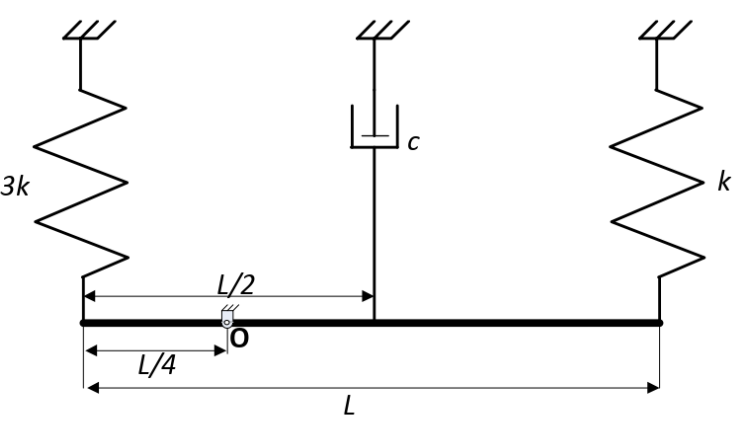
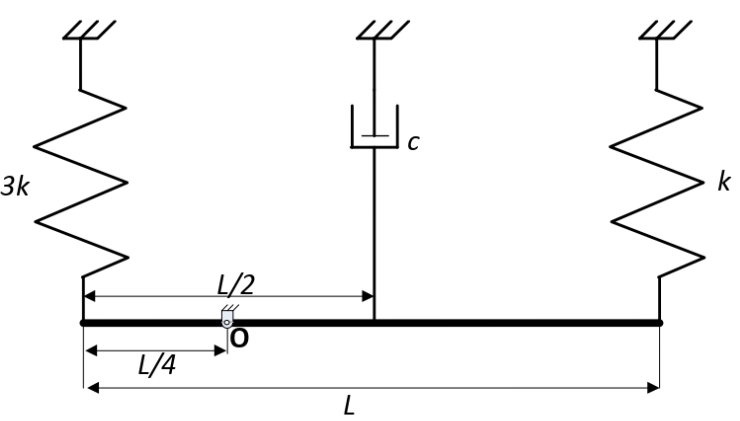
A slender uniform rigid bar of mass m is hinged at O and supported by two springs, with stiffnesses 3k and k, and a damper with damping coefficient ¢, as shown in the figure. For the system to be critically damped, the ratio c/√(km) should be
Correct Answer :
Solution :
The correct answer is 2 (or 4 depending on the physical attachment points of the components on the bar as shown in the figure).
Here is the step-by-step mathematical derivation of the critical damping condition for both cases:
1. General Governing Equation of Motion
For a rotational spring-mass-damper system pivoted at a hinge point , the equation of motion for a small angular displacement is given by:
2. Condition for Critical Damping
For any second-order system to be critically damped, the damping ratio must be equal to 1 (). This requires:
Case A: Derivation leading to the ratio
If the slender bar of length has negligible mass and carries a lumped mass at its free end, the mass moment of inertia about the pivot is:
Case B: Derivation leading to the ratio
If all elements (springs and damper) are connected in parallel at the same point (such as at the end of the bar of mass ), the system simplifies directly to a translational single-degree-of-freedom system with:
Access expert-curated educational resources and study materials—completely free.
Create, conduct, and manage professional online assessments with Crey. Perfect for teachers and institutes.
Copyright © 2026 Crey. All Rights Reserved.