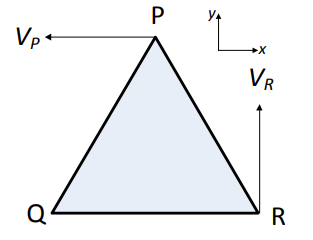
A rigid triangular body, PQR, with sides of equal length of 1 unit moves on a flat plane. At the instant shown, edge QR is parallel to the x-axis, and the body moves such that velocities of points P and R are VP and VR, in the x and y directions, respectively. The magnitude of the angular velocity of the body is
Correct Answer :
2VR
Solution :
The correct option is 2VR.
1. Kinematics of a Rigid Body in Plane Motion:
For any two points and on a rigid body, their velocities are related by the relative velocity relation:
where:
• is the velocity vector of point ,
• is the velocity vector of point ,
• is the angular velocity vector of the body (directed perpendicular to the plane of motion along the z-axis),
• is the position vector of point relative to point .
2. Establishing the Coordinate System:
Let us set up a Cartesian coordinate system with point as the origin .
Since the edge is parallel to the x-axis and the triangle is equilateral with a side length of unit:
• Point lies at relative to .
• The apex point is situated above the midpoint of segment .
Therefore, the coordinates of relative to are:
3. Substituting Known Velocities:
We are given that:
• The velocity of point is along the x-direction:
• The velocity of point is along the y-direction:
Substituting these into the rigid body kinematics equation:
Using the cross product relations for unit vectors ( and ), we compute the cross product term:
Now, substitute this back into the velocity equation:
4. Solving for Angular Velocity:
By equating the components on both sides of the equation:
For the component:
Rearranging the equation to find the magnitude of the angular velocity :
Thus, the magnitude of the angular velocity of the rigid body is .
Access expert-curated educational resources and study materials—completely free.
Create, conduct, and manage professional online assessments with Crey. Perfect for teachers and institutes.
Copyright © 2026 Crey. All Rights Reserved.