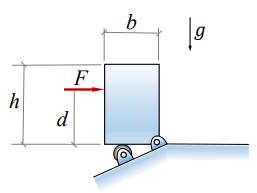
A rigid homogeneous uniform block of mass 1 kg, height h = 0.4 m and width b = 0.3 m is pinned at one corner and placed upright in a uniform gravitational field (g = 9.81 m/s2), supported by a roller in the configuration shown in the figure. A short duration (impulsive) force F, producing an impulse IF is applied at a height of d = 0.3 m from the bottom as shown. Assume all joints to be frictionless. The minimum value of IF required to topple the block is
Correct Answer :
Solution :
The correct option is 0.953 Ns.
1. Understanding the Toppling Condition:
The homogeneous rectangular block of mass m = 1 kg, height h = 0.4 m, and width b = 0.3 m is pinned at its bottom-right corner, which we denote as point O. The bottom-left corner is supported by a roller on an inclined surface.
To topple the block about the pivot corner O, the block must be rotated clockwise until its center of gravity G passes directly over the vertical line passing through O. Once it passes this point, the gravitational torque will act to continue the clockwise rotation and topple the block.
2. Determining the Initial and Critical Positions of the Center of Gravity:
In the upright starting position, the center of gravity G is located at the geometric center of the block:
Initially, the height of the center of gravity from the bottom edge is:
The distance from the pivot corner O to the center of gravity G is:
At the critical position (when G is vertically above O), the height of the center of gravity is exactly equal to the distance OG:
Therefore, the minimum change in height of the center of gravity required for toppling is:
3. Calculating the Moment of Inertia about point O:
Using the parallel axis theorem, the mass moment of inertia of the uniform block about the pinned corner O is:
Substituting the given values (m = 1 kg, b = 0.3 m, h = 0.4 m):
4. Applying Conservation of Energy:
Right after the impulse, the block rotates with an initial angular velocity about the pivot O. The kinetic energy imparted to the block must be at least equal to the potential energy gain needed to reach the critical toppling height:
Substitute the parameters to solve for the required angular velocity :
5. Relating Impulse to Angular Momentum:
The angular impulse about the pivot O is equal to the change in angular momentum of the block:
Given that the force is applied at a height of d = 0.3 m:
Access expert-curated educational resources and study materials—completely free.
Create, conduct, and manage professional online assessments with Crey. Perfect for teachers and institutes.
Copyright © 2026 Crey. All Rights Reserved.