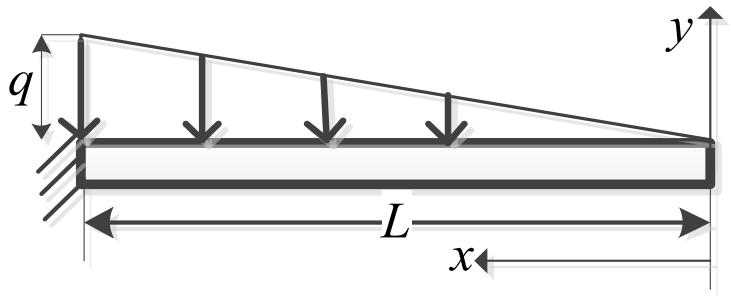
A prismatic, straight elastic, cantilever beam is subjected to a linearly distributed transverse load as shown below. If the beam length is L, Young’s modulus E, and area moment of inertia I, the magnitude of the maximum deflection is
Correct Answer :
qL4/30EI
Solution :
The correct option is qL4/30EI.
Let us derive the maximum deflection of a cantilever beam of length L, flexural rigidity EI, subjected to a linearly varying transverse load (triangular load) that increases from 0 at the free end (let's set at the free end) to a maximum value q at the fixed end ().
The intensity of the load at any distance x from the free end is given by:
To find the bending moment at a distance x from the free end, we consider the load acting on the segment of length x. The total load on this segment is the area of the triangular load distribution:
The centroid of this triangular load on the segment of length x lies at a distance of from the section at x. Thus, the bending moment is:
According to the Euler-Bernoulli beam theory, the governing differential equation for the deflection curve y is:
Integrating once with respect to x gives the slope equation:
Integrating a second time gives the deflection equation:
To determine the constants of integration and , we apply the boundary conditions at the fixed end ():
1. Slope is zero at the fixed support:
2. Deflection is zero at the fixed support:
The equation for the deflection curve is:
The maximum deflection occurs at the free end ():
Therefore, the magnitude of the maximum deflection is:
Access expert-curated educational resources and study materials—completely free.
Create, conduct, and manage professional online assessments with Crey. Perfect for teachers and institutes.
Copyright © 2026 Crey. All Rights Reserved.