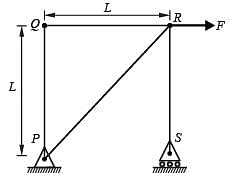
A plane truss PQRS (𝑷𝑸 = 𝑹𝑺, 𝐚𝐧𝐝 ∠𝑷𝑸𝑹 = 𝟗𝟎°) is shown in the figure.
The forces in the members PR and RS, respectively, are _____________
Correct Answer :
Solution :
Correct Answer: 𐒠√2 (tensile) and 𐒠 (compressive)
Step-by-Step Explanation:
1. Image Analysis & System Setup
Based on the first provided image, we have a plane truss with joints labeled P, Q, R, and S:
- Joint P is a pin support (hinged).
- Joint S is a roller support.
- The length of the vertical member PQ is labeled L, and the length of the horizontal member QR is also L.
- Since PQ = QR = L and the angle ∠PQR is 90°, the angle of the diagonal member PR with the horizontal member QR is:
- A horizontal force F acts at joint R pointing to the right.
2. Identifying Zero-Force Members
Let us analyze joint Q. At joint Q, there are only two non-collinear members PQ and QR, and there is no external load or reaction force acting on this joint.
For joint Q to be in equilibrium:
3. Joint R Equilibrium Analysis
Now, let's analyze joint R. As shown in the second image containing the free-body diagram:
- The horizontal member force FQR is zero.
- The external horizontal force is F acting to the right.
- There is a diagonal member force FPR at an angle of 45° to the horizontal.
- There is a vertical member force FRS acting vertically downwards along the line of member RS.
Assuming both FPR and FRS are tensile forces (pulling away from joint R):
Horizontal Equilibrium (ΣFx = 0):
Since the value is positive, our assumption of tension is correct. Hence, FPR = F√2 (tensile).
Vertical Equilibrium (ΣFy = 0):
Substituting FPR = F√2:
The negative sign indicates that the member force is compressive. Hence, FRS = F (compressive).
Conclusion:
The forces in members PR and RS are F√2 (tensile) and F (compressive) respectively.
Access expert-curated educational resources and study materials—completely free.
Create, conduct, and manage professional online assessments with Crey. Perfect for teachers and institutes.
Copyright © 2026 Crey. All Rights Reserved.