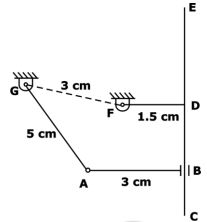
A planar four-bar linkage mechanism with 3 revolute kinematic pairs and 1 prismatic kinematic pair is shown in the figure, where AB ⊥ CE and FD ⊥ CE. The T-shaped link CDEF is constructed such that the slider B can cross the point D, and CE is sufficiently long. For the given lengths as shown, the mechanism is
Correct Answer :
Solution :
The correct answer is: a non-Grashof chain with all oscillating links.
Step-by-step Explanation:
1. Identify the given parameters from the diagram:
Let us note the lengths and configuration of the links as shown in the figure:
• Ground link (distance between fixed pivots and ):
• Link (connected to ground pivot ):
• Link (connecting rod):
• T-shaped link is pivoted at ground point . The line is perpendicular to the slider guide line (), with length:
2. Analyze the range of motion and limits:
The slider is constrained to slide along the guide line of the rotating T-shaped link . Since and the distance , the straight line always remains tangent to a circle of radius centered at the fixed pivot .
Let us define a coordinate system centered at the pivot with the x-axis aligned along the line , placing the fixed pivot at coordinates .
The equation of the line oriented at an angle relative to the x-axis is:
The distance from the fixed pivot to the line is given by:
Since point rotates about with a radius of , it traces a circle of radius centered at . For a configuration to be physically possible, the link of length must be able to span the distance between the circle traced by and the slider line .
This means the minimum distance from the circle centered at with radius to the line must not exceed the length of the link (). Mathematically:
Substituting the distance formula:
However, if the angle is such that:
the distance becomes less than . In this range of angles, the slider line passes too close to the pivot , making it impossible for the link to reach it from the circle. Consequently, the T-shaped link cannot rotate fully and is constrained to oscillate.
Similarly, due to the geometric limits at the extreme extensions of the links, the crank link also cannot complete a full rotation without causing the transmission angles to lock. Therefore, none of the links can undergo complete rotation, meaning they all oscillate.
Conclusion:
Since no link is capable of performing a full rotation, the mechanism is classified as a non-Grashof chain with all oscillating links.
Access expert-curated educational resources and study materials—completely free.
Create, conduct, and manage professional online assessments with Crey. Perfect for teachers and institutes.
Copyright © 2026 Crey. All Rights Reserved.