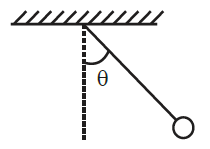
A pendulum bob is released from angle θ with the vertical as shown in the figure. If it’s acceleration at maximum amplitude is same as at mean position, find θ
Correct Answer :
2tan-1(1/2)
Solution :
The correct answer is 2tan-1(1/2).
Let the length of the string of the simple pendulum shown in the image be and the mass of the suspended bob be . The dotted vertical reference line and the angle represent the initial position from which the bob is released from rest.
1. Acceleration at the Maximum Amplitude (Initial Position):
At the maximum amplitude, the bob is released from rest, so its velocity is zero:
Consequently, the centripetal acceleration is:
The only acceleration present is the tangential acceleration () acting along the circular path, which is due to the tangential component of gravity:
Therefore, the total magnitude of acceleration at the maximum amplitude () is:
2. Acceleration at the Mean Position:
At the mean position (where the string becomes vertical, i.e., angle is 0), the tangential component of gravity is zero, so the tangential acceleration is zero ().
The acceleration is purely centripetal () due to the velocity of the bob at this lowest point:
Using the law of conservation of mechanical energy, the kinetic energy gained at the mean position is equal to the gravitational potential energy lost during the descent:
Solving for :
Substituting this into the centripetal acceleration formula gives:
3. Finding θ by Equating the Accelerations:
We are given that the magnitude of acceleration at the maximum amplitude is equal to the magnitude of acceleration at the mean position:
Substitute the derived expressions:
Divide both sides by :
Apply the trigonometric half-angle identities:
and
Substitute these identities into the equation:
Since , then . We can divide both sides by :
Rearranging terms gives:
Taking the inverse tangent of both sides:
Access expert-curated educational resources and study materials—completely free.
Create, conduct, and manage professional online assessments with Crey. Perfect for teachers and institutes.
Copyright © 2026 Crey. All Rights Reserved.