A particle performing simple harmonic motion according to y = A sinωt. Then its kinetic energy (K.E.), potential energy (P.E.) and speed (V) at position y = A/2 are
Correct Answer :
Solution :
The correct option is:
Step-by-Step Derivation:
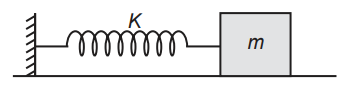
The attached image shows a mass-spring system consisting of a block of mass m attached to a spring of spring constant K on a horizontal surface, executing simple harmonic motion (SHM).
1. Potential Energy (P.E.):
The potential energy of a particle performing SHM at any displacement y from the mean position is given by:
Given that the particle is at position:
Substituting y into the potential energy formula:
2. Kinetic Energy (K.E.):
The total mechanical energy (E) of the particle performing SHM with amplitude A is:
Since total energy is the sum of kinetic energy and potential energy:
Therefore, the kinetic energy is:
Substituting the values of E and P.E.:
3. Speed (V):
The kinetic energy is also given by the formula:
Equating the two expressions for kinetic energy:
Solving for V2:
Taking the square root on both sides:
Access expert-curated educational resources and study materials—completely free.
Create, conduct, and manage professional online assessments with Crey. Perfect for teachers and institutes.
Copyright © 2026 Crey. All Rights Reserved.