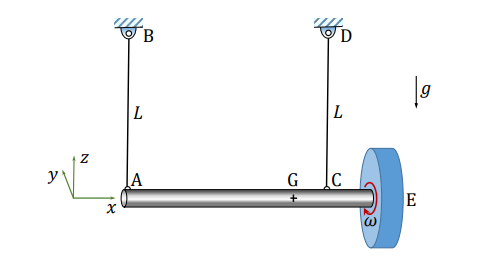
A massive uniform rigid circular disc is mounted on a frictionless bearing at the end E of a massive uniform rigid shaft AE which is suspended horizontally in a uniform gravitational field by two identical light inextensible strings AB and CD as shown, where G is the center of mass of the shaft-disc assembly and 𝑔 is the acceleration due to gravity. The disc is then given a rapid spin 𝜔 about its axis in the positive x-axis direction as shown, while the shaft remains at rest. The direction of rotation is defined by using the right-hand thumb rule. If the string AB is suddenly cut, assuming negligible energy dissipation, the shaft AE will
Correct Answer :
Solution :
The correct option is: rotate slowly (compared to 𝜔) about the negative z-axis direction.
1. Initial State and Coordinate Setup:
Based on the coordinate system provided in the diagram:
• The shaft lies along the positive -axis.
• The vertical direction is represented by the -axis (positive upwards, along which gravity acts downwards with acceleration ).
• The -axis is perpendicular to the - and -axes, defining a right-handed system.
• The disc at end spins rapidly at angular velocity in the positive -axis direction. Thus, the spin angular momentum vector is:
where is the moment of inertia of the disc about its spin axis.
2. Effect of Cutting String AB:
• Originally, the shaft is supported by two strings: one at (string ) and one at (string ).
• The center of mass of the shaft-disc assembly, , is located to the left of the support point (towards point ).
• When the string is cut, the point acts as the instantaneous pivot point.
• The force of gravity acts downwards at :
• The position vector of the center of mass relative to the pivot is in the negative -direction:
where is the horizontal distance between and .
3. Torque Due to Gravity:
The gravitational torque about the pivot point is:
Since , the torque vector is directed along the negative -axis:
4. Gyroscopic Precession:
The torque causes a change in the angular momentum vector over time according to:
For a system precessing at an angular velocity of precession , the relationship between torque and precession is:
Let represent the precession about the vertical -axis. Substituting the vectors:
Solving for :
The negative sign indicates that the precession angular velocity vector points in the negative z-axis direction. Since the disc's spin is very rapid, the magnitude of the precession angular velocity is small compared to . Therefore, the shaft will rotate slowly about the negative -axis direction.
Access expert-curated educational resources and study materials—completely free.
Create, conduct, and manage professional online assessments with Crey. Perfect for teachers and institutes.
Copyright © 2026 Crey. All Rights Reserved.