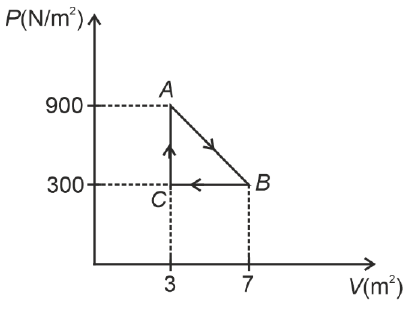
A gas undergoes a cyclic process ABCA as shown. Find the work done by the gas for A ⎯→ B ⎯→ C.
Correct Answer :
Solution :
The correct option is 1200 J.
To find the total work done by the gas during the process A ⎯→ B ⎯→ C, we analyze the pressure-volume () diagram provided in the image:
- The vertical axis representing pressure () is in units of and shows values of 300 and 900.
- The horizontal axis representing volume () is in units of and shows values of 3 and 7.
- From the diagram, the coordinates of the states are:
State A:
State B:
State C:
The total work done is the sum of the work done in path A ⎯→ B and path B ⎯��� C:
Step 1: Work done during the path A ⎯→ B ()
The path A ⎯→ B is a straight line on the diagram. The work done is equal to the area under the line AB, which is a trapezoid bounded by and :
Substituting the values from the graph:
Step 2: Work done during the path B ⎯→ C ()
The path B ⎯→ C is an isobaric compression at a constant pressure of . The volume decreases from to :
Substituting the values from the graph:
Step 3: Total work done ()
Summing the work done in both steps:
Access expert-curated educational resources and study materials—completely free.
Create, conduct, and manage professional online assessments with Crey. Perfect for teachers and institutes.
Copyright © 2026 Crey. All Rights Reserved.