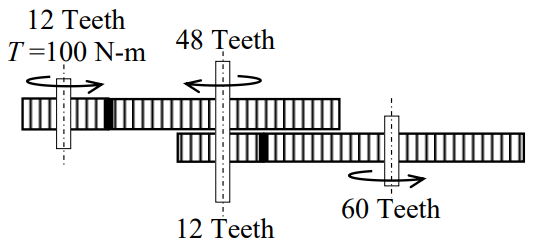
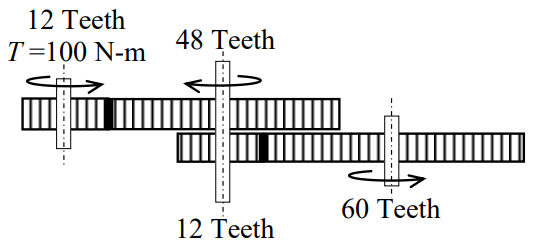
A frictionless gear train is shown in the figure. The leftmost 12-teeth gear is given a torque of 100 N-m. The output torque from the 60-teeth gear on the right in N-m is
Correct Answer :
2000
Solution :
The correct option is 2000.
Analysis of the Gear Train:
Based on the provided diagram, we can identify a compound gear train configuration consisting of three shafts:
1. Input Shaft (Left): Carries a gear with 12 teeth, subjected to an input torque of .
2. Intermediate Shaft (Middle): Carries a compound gear system consisting of a larger gear with 48 teeth (which meshes with the input gear) and a smaller gear with 12 teeth sharing the same shaft.
3. Output Shaft (Right): Carries a gear with 60 teeth, which meshes with the 12-teeth intermediate gear.
Step 1: Calculate the Speed Ratios
For any pair of meshing gears, the speed of rotation is inversely proportional to the number of teeth. Let represent the rotational speed (rpm) and represent the number of teeth.
For the first gear mesh (input gear with 12 teeth to the intermediate gear with 48 teeth):
Since the 48-teeth gear and the second 12-teeth gear are mounted on the same intermediate shaft, they rotate at the same speed:
For the second gear mesh (intermediate gear with 12 teeth to the output gear with 60 teeth):
Step 2: Determine the Overall Gear Train Ratio
The overall speed ratio (velocity ratio) of the compound gear train is the product of the individual stage ratios:
Step 3: Calculate the Output Torque
Since the gear train is frictionless, mechanical power is conserved during transmission ():
where represents angular velocity. This relationship allows us to solve for the output torque as follows:
Substituting the given values:
Therefore, the output torque from the 60-teeth gear is 2000 N-m.
Access expert-curated educational resources and study materials—completely free.
Create, conduct, and manage professional online assessments with Crey. Perfect for teachers and institutes.
Copyright © 2026 Crey. All Rights Reserved.