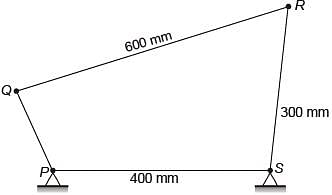
A four bar mechanism is shown below. For the mechanism to be a crank-rocker mechanism, the length of the link PQ can be
Correct Answer :
Solution :
The correct option is 80 mm.
Analysis of the Given Four-Bar Mechanism:
Based on the provided schematic diagram (image 0), we can identify the joints and link lengths of the four-bar mechanism as follows:
1. Ground (fixed) link:
2. Coupler link:
3. Follower link:
4. Input link: (with unknown length )
Grashof's Law and Crank-Rocker Conditions:
According to Grashof's law, for a four-bar linkage to have at least one link that can make a complete rotation of (making it a Grashof linkage), the sum of the lengths of the shortest () and longest () links must be less than or equal to the sum of the lengths of the remaining two links ( and ):
For a linkage to specifically function as a crank-rocker mechanism:
1. The Grashof inequality must be satisfied.
2. The shortest link must be the crank (the link that rotates fully), and it must be adjacent to the fixed link.
Step-by-Step Derivation:
Since the fixed link is , the adjacent link must be the shortest link () to act as the crank.
Since is the shortest link, its length must be smaller than all other link lengths:
Under this condition, the longest link is the coupler link, ().
The other two intermediate links are:
(link ) and (link ).
Applying the Grashof inequality:
Conclusion:
For the mechanism to behave as a crank-rocker, the length of the link must be less than or equal to .
Among the given options (80 mm, 200 mm, 300 mm, 350 mm), only 80 mm satisfies this criteria ().
Access expert-curated educational resources and study materials—completely free.
Create, conduct, and manage professional online assessments with Crey. Perfect for teachers and institutes.
Copyright © 2026 Crey. All Rights Reserved.