
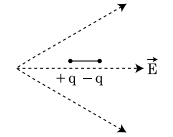
A dipole is placed in an electric field as shown. In which direction will it move?
Correct Answer :
Solution :
The correct option is: Towards the right as its potential energy will decrease.
Step-by-step Explanation:
1. Analyzing the Electric Field:
In the given diagram, the electric field lines originate from a region on the left and diverge as they propagate towards the right. The density of electric field lines represents the strength of the electric field. Since the lines are closer together on the left side and farther apart on the right side, the electric field is non-uniform and stronger on the left than on the right:
2. Forces on the Dipole Charges:
The dipole consists of a positive charge
on the left and a negative charge
on the right:
- The force on the positive charge
acts in the direction of the electric field (towards the right):
- The force on the negative charge
acts opposite to the direction of the electric field (towards the left):
3. Determining the Net Force and Direction of Motion:
Since the electric field is stronger on the left:
Because the rightward force is greater than the leftward force, the net force on the dipole is directed towards the right. Consequently, the dipole will accelerate and move towards the right.
4. Relationship with Potential Energy:
Every system naturally tends to move in a direction that minimizes its potential energy. Since the dipole moves in the direction of the net electrostatic force, work is done by the electric field, which leads to a decrease in the system's potential energy.
Access expert-curated educational resources and study materials—completely free.
Create, conduct, and manage professional online assessments with Crey. Perfect for teachers and institutes.
Copyright © 2026 Crey. All Rights Reserved.




