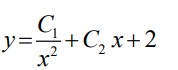
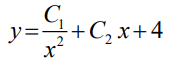
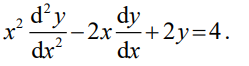
A differential equation is given as  The solution of the differential equation in
terms of arbitrary constants C1 and C2 is bhjvhhgghvhbjj
The solution of the differential equation in
terms of arbitrary constants C1 and C2 is bhjvhhgghvhbjj
Correct Answer :
Solution :
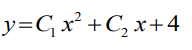
The correct option is:
Analysis of the Question:
From the provided images, the differential equation to solve is:
This equation is a second-order Cauchy-Euler differential equation (also known as a homogeneous linear differential equation).
Step 1: Substitution to constant coefficient form
To solve this, we introduce a new independent variable using the substitution:
Using the chain rule, we can relate the derivatives with respect to to derivatives with respect to . Let :
And for the second derivative:
Substituting these expressions into our original differential equation gives:
Expanding and simplifying the operator:
Step 2: Finding the Complementary Function (CF)
To find the complementary function , we solve the homogeneous equation:
The corresponding auxiliary algebraic equation is:
Factoring the quadratic expression:
Which yields the real and distinct roots:
Thus, the solution of the homogeneous equation in terms of is:
Substituting back into the equation:
Step 3: Finding the Particular Integral (PI)
The particular integral is calculated for the non-homogeneous term:
We can write the constant as . According to the rules for finding the PI of an exponential term , we substitute :
Step 4: Writing the General Solution
The complete general solution is the sum of the complementary function and the particular integral:
Access expert-curated educational resources and study materials—completely free.
Create, conduct, and manage professional online assessments with Crey. Perfect for teachers and institutes.
Copyright © 2026 Crey. All Rights Reserved.