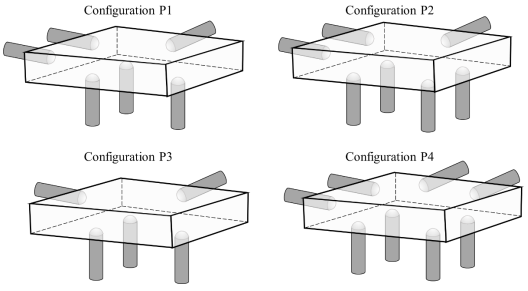
A cuboidal part has to be accurately positioned first, arresting six degrees of freedom and then clamped in a fixture, to be used for machining. Locating pins in the form of cylinders with hemi-spherical tips are to be placed on the fixture for positioning. Four different configurations of locating pins are proposed as shown. Which one of the options given is correct?
Correct Answer :
Configuration P1 arrests 6 degrees of freedom, while Configurations P2 and P4 are over-constrained and Configuration P3 is under-constrained.
Solution :
Correct Answer:
Configuration P1 arrests 6 degrees of freedom, while Configurations P2 and P4 are over-constrained and Configuration P3 is under-constrained.
Detailed Explanation:
1. Understanding the 3-2-1 Principle of Location
To accurately position a cuboidal workpiece in a fixture for machining, we must arrest its degrees of freedom (DoF). A free rigid body in three-dimensional space has 6 degrees of freedom:
• 3 translational movements along the X, Y, and Z axes.
• 3 rotational movements about the X, Y, and Z axes.
To prevent movement in these directions, locating pins are placed against three mutually perpendicular datum planes using the 3-2-1 principle:
• Primary Datum Plane (3 pins): Placing three pins on the bottom horizontal surface establishes a plane. This arrests 3 degrees of freedom (1 translation along the vertical axis, and 2 rotations about the horizontal axes).
• Secondary Datum Plane (2 pins): Placing two pins on a vertical side surface arrests 2 degrees of freedom (1 translation perpendicular to that surface, and 1 rotation about the remaining axis).
• Tertiary Datum Plane (1 pin): Placing one pin on a perpendicular vertical end surface arrests the final 1 degree of freedom (translation perpendicular to this surface).
2. Analyzing the Configurations shown in the Image
Configuration P1:
• Bottom surface: contains 3 vertical locating pins with hemi-spherical tips.
• Back vertical surface: contains 2 horizontal locating pins.
• Left vertical surface: contains 1 horizontal locating pin.
This matches the 3-2-1 principle exactly. Therefore, Configuration P1 arrests exactly 6 degrees of freedom and provides correct and stable positioning.
Configuration P2:
• Bottom surface: contains 4 vertical locating pins.
• Back vertical surface: contains 2 horizontal locating pins.
• Left vertical surface: contains 1 horizontal locating pin.
Since three points are mathematically sufficient to define a plane, the fourth pin on the bottom surface introduces a redundant constraint. This leads to a total of 7 pins, making Configuration P2 over-constrained (which can cause the part to rock if the surface is not perfectly flat).
Configuration P3:
• Bottom surface: contains 3 vertical locating pins.
• Back vertical surface: contains only 1 horizontal locating pin.
• Left vertical surface: contains 1 horizontal locating pin.
With only 1 pin on the back surface, the workpiece is free to rotate about the vertical axis. Having a total of 5 pins means Configuration P3 is under-constrained.
Configuration P4:
• Bottom surface: contains 4 vertical locating pins.
• Back vertical surface: contains 2 horizontal locating pins.
• Left vertical surface: contains 2 horizontal locating pins.
With a total of 8 locating pins, this layout has multiple redundant constraints on both the bottom and side planes, making Configuration P4 highly over-constrained.
Access expert-curated educational resources and study materials—completely free.
Create, conduct, and manage professional online assessments with Crey. Perfect for teachers and institutes.
Copyright © 2026 Crey. All Rights Reserved.