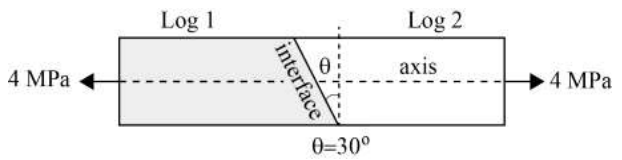
A carpenter glues a pair of cylindrical wooden logs by bonding their end faces at an angle of of 30° as shown in the figure.
The glue used at the interface fails if
Criterion 1: the maximum normal stress exceeds 2.5 MPa.
Criterion 2: the maximum shear stress exceeds 1.5 MPa.
Assume that the interface fails before the logs fail. When a uniform tensile stress of 4 MPa is applied, the interface
Correct Answer :
fails because of both criteria 1 and 2
Solution :
The correct option is: fails because of both criteria 1 and 2.
Analysis of the Problem:
From the provided image, we have two cylindrical logs (Log 1 and Log 2) bonded at an inclined interface. The horizontal axis of loading has a uniform tensile stress applied to it:
The vertical dotted line represents a plane perpendicular to the longitudinal axis of the logs. The inclined interface makes an angle of:
with this vertical plane.
Therefore, the normal to the inclined interface plane makes the same angle with the axis of loading (the horizontal axis along which the tensile stress is applied).
1. Calculation of Normal Stress () on the Interface:
The normal stress acting on an inclined plane at an angle to the cross-sectional plane is given by the formula:
Substituting the given values into the formula:
2. Calculation of Shear Stress () on the Interface:
The shear stress acting on the inclined plane is given by the formula:
Substituting the given values:
3. Evaluation of Failure Criteria:
We compare the calculated stresses with the given threshold limits at the interface:
Since both failure limits are exceeded, the glued interface fails due to both criteria 1 and 2.
Access expert-curated educational resources and study materials—completely free.
Create, conduct, and manage professional online assessments with Crey. Perfect for teachers and institutes.
Copyright © 2026 Crey. All Rights Reserved.