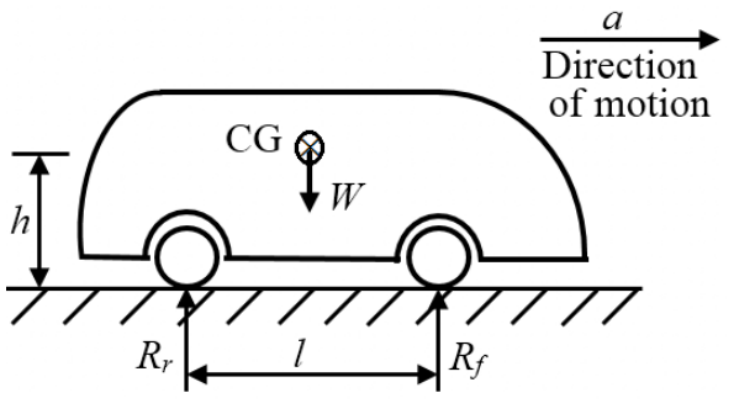
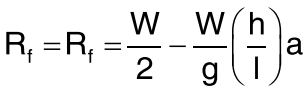
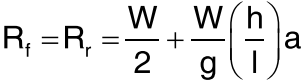
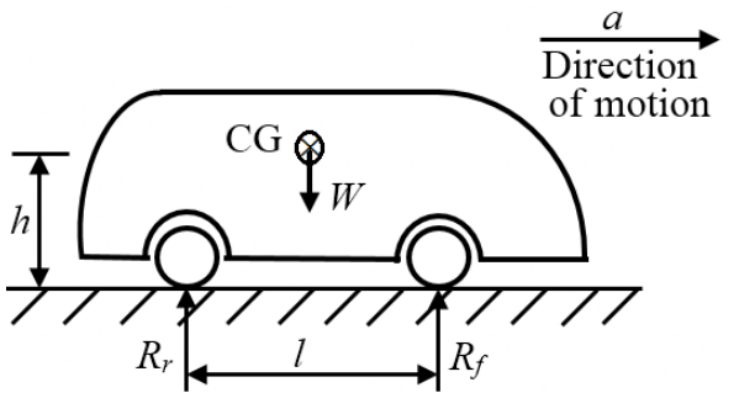
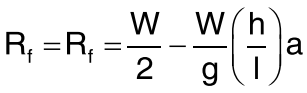
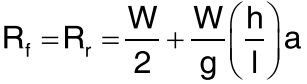
A car is having weight W is moving in the direction as shown in the figure. The centre of gravity (CG) of the car is located at height h from the ground, midway between the front and rear wheels. The distance between the front and rear wheels, is l. The acceleration of the car is a, and acceleration due to gravity is g. The reactions on the front wheels (Rf ) and rear wheels (Rr ) are given by
Correct Answer :
Solution :
The correct reactions on the front wheels (Rf) and rear wheels (Rr) are:
Step-by-Step Derivation and Analysis:
Based on the schematic diagram of the accelerating car, let's identify the forces acting on the vehicle:
1. Weight (W): The total weight of the car acting downwards at the center of gravity (CG). Since the CG is located midway between the front and rear wheels, it lies at a horizontal distance of from both axles.
2. Normal Reactions (Rf and Rr): The vertical upward normal reaction forces exerted by the ground on the front and rear wheels, respectively.
3. Inertial Force (Fi): Since the car is accelerating forward with an acceleration a, we can analyze the system in the car's accelerating reference frame by introducing a backward pseudo-force (inertial force) acting horizontally through the CG at height h from the ground:
1. Balancing the Vertical Forces:
Under vertical equilibrium, the sum of upward forces must equal the total downward force:
2. Taking Moments about the Rear Wheel Contact Point on the Ground:
To find the front reaction force Rf, we sum the moments about the contact point of the rear wheels with the ground. For rotational equilibrium, the sum of clockwise moments must balance the sum of counter-clockwise moments:
Substitute the expression for inertial force :
Solve for Rf by dividing both sides by l:
3. Taking Moments about the Front Wheel Contact Point on the Ground:
Similarly, taking moments about the contact point of the front wheels with the ground:
Substitute the expression for :
Divide by l to solve for Rr:
Conclusion:
During acceleration, load transfer occurs from the front wheels to the rear wheels. As a result, the reaction force on the front wheels decreases, while the reaction force on the rear wheels increases by the dynamic factor .
Access expert-curated educational resources and study materials—completely free.
Create, conduct, and manage professional online assessments with Crey. Perfect for teachers and institutes.
Copyright © 2026 Crey. All Rights Reserved.