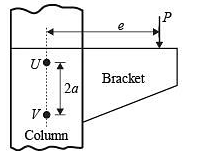
A bracket is attached to a vertical column by means of two identical rivets U and V separated by a distance of 2a = 100 mm, as shown in the figure. The permissible shear stress of the rivet material is 50 MPa. If a load P = 10 kN is applied at an eccentricity 𝑒 = 3√7 𝑎, the minimum cross-sectional area of each of the rivets to avoid failure is ___________ mm2 .
Correct Answer :
Solution :
Correct Answer/Option: The correct option is 800.
Step-by-step Explanation:
1. Understanding the Given Data:
From the problem statement and the attached schematic diagram, we have:
2. Direct (Primary) Shear Force on Rivets:
The direct vertical load is distributed equally between the two identical rivets. The primary shear force () on each rivet acts vertically downwards and is given by:
Substituting :
3. Secondary Shear Force due to Eccentric Moment:
The eccentric load creates a clockwise moment about the centroid :
This moment is resisted by the secondary shear forces () on the rivets. The secondary shear force on any rivet at distance from the centroid is:
Since , the secondary shear force on both rivets is equal and is given by:
Now substitute into the equation:
4. Determining the Direction of Secondary Shear Forces:
The eccentric load causes a clockwise moment. To resist this:
5. Calculating the Resultant Shear Force:
The resultant shear force on each rivet is:
Substitute the values of and in terms of :
Substituting :
6. Calculation of Minimum Cross-Sectional Area:
To avoid failure, the shear stress in each rivet must not exceed the permissible value:
Therefore, the minimum cross-sectional area is:
Access expert-curated educational resources and study materials—completely free.
Create, conduct, and manage professional online assessments with Crey. Perfect for teachers and institutes.
Copyright © 2026 Crey. All Rights Reserved.