
NEET (UG)-2026 Chemistry Code-12 Question Paper with Solutions

# Q1 of 45

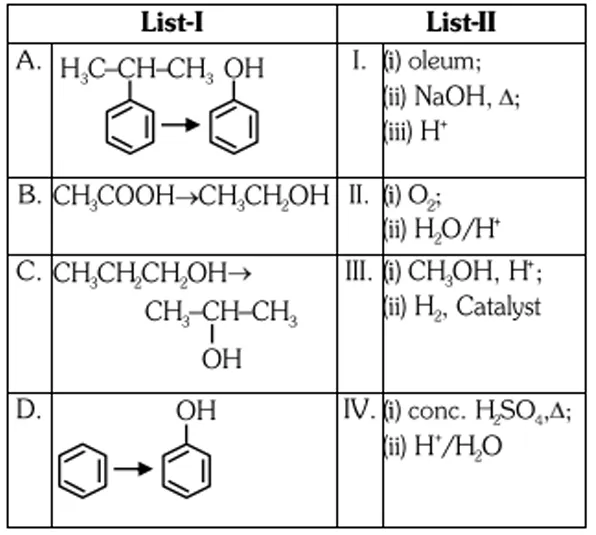
Match List I with List II for the given chemical transformations and their corresponding reagents or reaction types.
Options
A.

A-I, B-III, C-IV, D-II

B.

A-II, B-IV, C-III, D-I

C.

A-II, B-III, C-I, D-IV

D.

A-II, B-III, C-IV, D-I

Show Answer
Correct Answer

A-II, B-III, C-IV, D-I

Solution

Step 1: Understanding the Question:

The question asks to match specific organic conversions (List I) with the appropriate sets of reagents or reaction conditions (List II).

This involves identifying well-known industrial and laboratory processes such as the Cumene process for phenol, esterification followed by reduction, dehydration of alcohols, and sulfonation-fusion for phenol synthesis.


Step 2: Key Formula or Approach:

The approach involves identifying the functional group changes and matching them with the corresponding standard reaction sequences in organic chemistry.


Step 3: Detailed Explanation:

  • Conversion A (Isopropylbenzene to Phenol):

    This is the industrial Cumene process.

    Isopropylbenzene (cumene) is first oxidized by air (O2) to form cumene hydroperoxide.

    Subsequent treatment with dilute acid (H2O/H+) results in its decomposition into phenol and acetone.

    This matches List II condition II:

    (i) O2; (ii) H2O/H+.

  • Conversion B (Acetic acid to Ethanol):

    Acetic acid (CH3COOH) cannot be directly reduced easily by catalytic hydrogenation.

    A common route is to first esterify it with methanol (CH3OH) in the presence of an acid catalyst to form methyl acetate, which is then easily reduced to ethanol and methanol using hydrogen and a catalyst.

    This matches List II condition III:

    (i) CH3OH, H+; (ii) H2, catalyst.

  • Conversion C (Propan-1-ol to Propene):

    This is a classic dehydration reaction of a primary alcohol.

    Heating propan-1-ol with concentrated sulfuric acid (H2SO4) at high temperatures (around 443 K) leads to the elimination of water to form propene.

    This matches List II condition IV:

    (i) conc. H2SO4, Δ; (ii) H+/H2O.

  • Conversion D (Benzene to Phenol):

    Benzene can be converted to phenol via the benzenesulfonic acid route.

    First, benzene is sulfonated with oleum to give benzenesulfonic acid.

    Then, it is fused with molten NaOH at high temperature to form sodium phenoxide, which is finally acidified to yield phenol.

    This matches List II condition I:

    (i) oleum; (ii) NaOH, Δ; (iii) H+.

  • Combining these: A-II, B-III, C-IV, D-I.

Step 4: Final Answer:

Based on the mechanistic match of each conversion with the given reagents, option (D) is the correct choice.

Questions
