
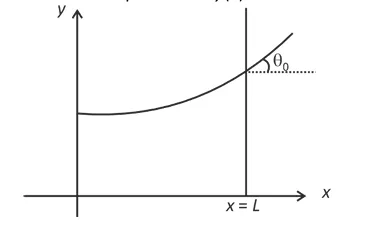
Consider a water tank shown in the figure. It has one wall at x = L and can be taken to be very wide in the z direction. When filled with a liquid of surface tension S and density ρ, the liquid surface makes angle θ0 (θ0 << 1) with the x-axis at x = L. If y(x) is the height of the surface then the equation for y(x) is:
The correct option is:
Step-by-Step Explanation:
1. Analyze the System and Image:
As shown in the figure, a liquid of density ρ and surface tension S is contained in a wide tank. A vertical wall is located at x = L. Near the wall, the liquid surface rises to form a meniscus. The height of the meniscus at any position x is represented by y(x), and the surface makes an angle θ0 with the horizontal (the x-axis) at x = L.
2. Hydrostatic Pressure:
Let the flat, undisturbed surface of the liquid far from the wall be at y = 0, where the pressure is atmospheric pressure P0.
At any point x along the meniscus, the height of the liquid is y. Due to hydrostatic equilibrium, the pressure in the liquid just below the curved surface at height y is lower than the atmospheric pressure P0 by the weight of the raised column of liquid:
3. Excess Pressure due to Surface Tension (Laplace's Law):
The curved boundary of the liquid surface creates a pressure difference across it due to surface tension. According to Laplace's formula for a surface curved in one dimension (since the tank is very wide in the z direction):
where R is the radius of curvature of the liquid surface profile y(x).
4. Curvature and Small Angle Approximation:
The curvature 1/R of the profile y(x) is mathematically defined as:
We are given that the angle θ(x) of the surface with the horizontal is very small (θ(x) << 1). Therefore, the slope of the surface is also very small:
Thus, the term in the denominator is negligible compared to 1, giving the approximation:
5. Formulating the Differential Equation:
Now we substitute the pressure relations and the curvature approximation into Laplace's equation:
Simplifying the left-hand side:
Rearranging for the second derivative of y with respect to x yields: