
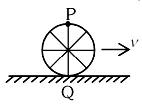
A wheel of a bullock cart is rolling on a level road as shown in the figure below. If its linear speed is v in the direction shown, which one of the following options is correct (P and Q are any highest and lowest points on the wheel, respectively)?
Point P moves slower than point Q
Point P moves faster than point Q
Both the points P and Q move with equal speed
Point P has zero speed
Point P moves faster than point Q
The correct option is Point P moves faster than point Q.
Analysis of the Image:
The provided image shows a wheel of a bullock cart with spokes, rolling without slipping on a horizontal level road (indicated by the hashed ground line).
The highest point at the top of the wheel is labeled P, and the lowest point in contact with the ground is labeled Q.
An arrow with the label points to the right, representing the linear velocity of the wheel's center of mass.
Step-by-Step Explanation:
When a wheel rolls without slipping on a flat surface, its motion can be understood as a combination of two simultaneous motions:
1. Translational Motion: Every point on the wheel translates forward with a velocity equal to the velocity of the center of mass:
2. Rotational Motion: The wheel rotates about its center of mass with an angular velocity:
where is the radius of the wheel. Due to this rotation, any point at a distance from the center has a tangential speed of:
The net velocity of any point on the wheel is the vector sum of its translational velocity and its rotational (tangential) velocity:
Let us calculate the net velocity for the points P and Q:
1. For Point P (Highest Point):
At the highest point P, the translational velocity is directed horizontally forward (to the right), and the tangential velocity due to rotation is also directed horizontally forward (to the right).
Since both vector components point in the same direction, they add up:
2. For Point Q (Lowest Point):
At the lowest point Q (the point of contact with the road), the translational velocity is directed horizontally forward (to the right).
However, the tangential velocity due to rotation points horizontally backward (to the left).
Since these two components point in opposite directions, they subtract from one another:
Conclusion:
The speed of point P is and the speed of point Q is . Therefore, point P moves faster than point Q.
Connect directly for comprehensive question sets, study material & courses.
